A downhill yard feels like wasted space until you see it the right way. Down sloped backyard ideas aren’t about forcing your lot to look flat, they’re about using the drop in elevation to your advantage. Water runoff, tricky mowing, and awkward sightlines are the real problems, and every idea below is built to solve one of them while still giving you a yard people actually want to use.
Homeowners will often think that being on a slope will limit the possibilities. This is not the case, as being on a slope makes the choices in terms of layout endless, as you cannot have tiered gardens, fire pits, framing on a flat ground. You need to pick the correct option depending on the type of slope you have.
What Makes a Down Sloped Backyard Different to Plan For
A downward slope takes water from your house to the houses of your neighbors or towards the streets or the lowest part of your yard. This is one thing that governs every other design choice you make from patios to the types of plants that can grow there.
Erosion is the second issue. Loose soil, exposed roots, and bare patches after heavy rain are signs the slope is shedding topsoil faster than grass or groundcover can hold it. Any down sloped backyard ideas you shortlist need to address drainage and erosion first; aesthetics come second.
Gentle Slopes vs. Steep Slopes: Why the Distinction Matters
With a mild slope (around 1-10%), grading, mulching, and tough ground cover is sufficient. With a steep slope (more than 15%), structural measures such as retaining walls, terracing, or artificial drainage become necessary since loose soil on a steep slope will simply continue to slip despite whatever kind of plants are used.
It will save you money in the long run if you know the slope of the land prior to planning. An easy way to do this would be by putting stakes at both ends of the slope, stretching out a string line level, and measuring the height of the string above ground at the lower end stake divided by the horizontal distance.
Top Down Sloped Backyard Ideas for Every Budget
This is the list of recurring solutions for designing effective sloping yards which are organized according to the problem they address rather than their visual nature.
Terracing for Layered Garden Beds
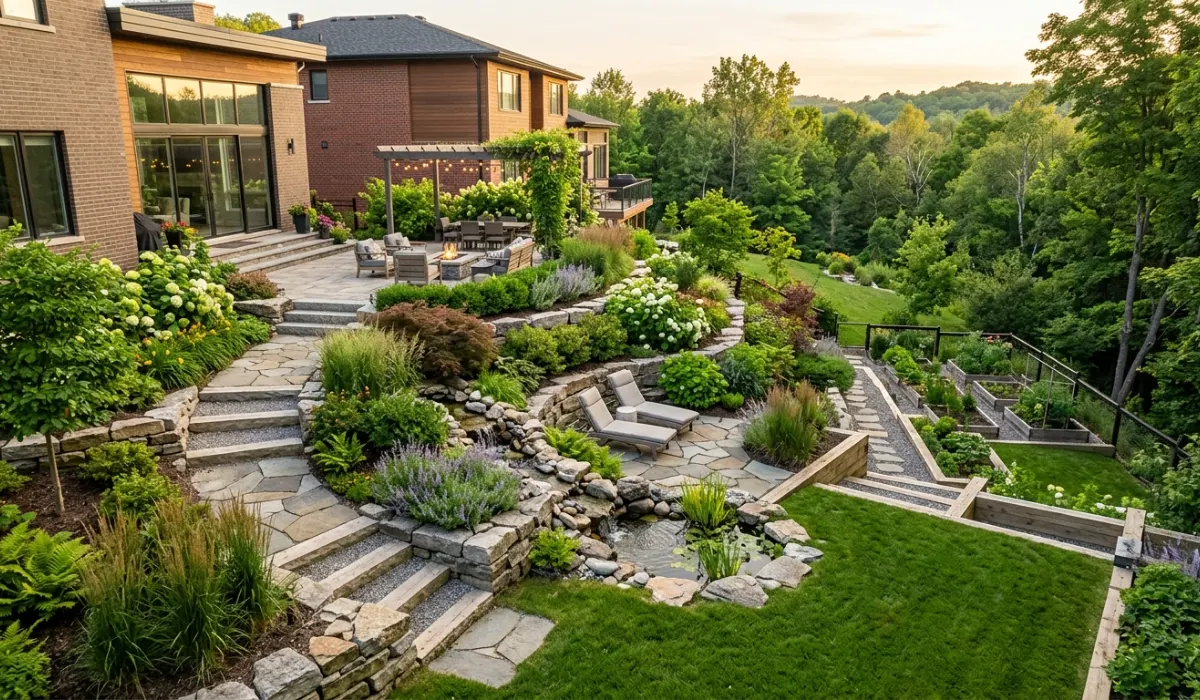
Terracing breaks a continuous slope into flat, stacked platforms, each held in place by a low wall of timber, stone, or concrete block. It’s one of the most effective down sloped backyard ideas for turning unusable ground into planting space, because each terrace acts as its own mini flat yard.
Build from the bottom up, compacting soil at each level before you fill the bed above it. This keeps upper terraces from shifting once they’re loaded with soil and plants.
Multi-Level Decks That Follow the Slope
Rather than battling the grade, the tiered deck aligns with it using two platforms, with the first at the top next to the house and the second below it, linked together with steps.
This is particularly effective when the land is very steep, making it impossible to comfortably navigate or mow the area.
Decking on stilts eliminates much of the digging that a patio requires, thus being less expensive than paving even though it is more expensive per square foot of material used.
Retaining Walls as Structural and Design Elements
Retaining walls keep soil in place, but serve as a design element as well; stones, concrete, and blocks can be used depending on your resources and design aesthetic. In any case, once you go beyond an elevation change of about four feet, a wall actually prevents erosion, rather than slows it.
However, a taller wall must have adequate drainage behind it, otherwise hydrostatic pressure will eventually destroy the wall itself. This is one example where skimping upfront will cost you much more in the end to correct.
Stone Steps and Pathways for Safe Movement
Steps give a slope direction and make it genuinely usable rather than just decorative. Stone or paver steps connecting your terraces or deck levels turn a hazard into a controlled, safe route through the yard.
A curved path that follows the natural contour of the land tends to feel more organic than a straight staircase, though straight runs are cheaper and easier to build if budget is the priority.
Fire Pits and Seating Nooks on a Leveled Platform
Carving out one flat platform partway down the slope just large enough for a fire pit and a few chairs is a low-cost way to create a destination in an otherwise unused part of the yard. It doesn’t require leveling the whole property, just one manageable section.
Pair it with low retaining edges or large boulders to hold the platform in place, and you’ve got a functional space for a fraction of the cost of a full regrade.
Edible and Ornamental Terraced Gardens
Vegetable beds serve double duty on a slope: they hold soil in place with root systems while producing a harvest. Stone-circled raised beds connected by a timber step path work well on gradual slopes, while switchback terraces retained with timber handle steeper grades.
Rain Gardens and Bioswales at the Base of the Slope
A rain garden sits at the lowest point of your yard and captures runoff in a shallow, planted basin where it can soak into the ground slowly instead of pooling or washing further downhill. It’s one of the most functional down sloped backyard ideas because it turns a drainage problem into a planted feature.
Native, water-tolerant plants (sedges, switchgrass, swamp milkweed) handle the alternating wet and dry conditions a rain garden creates better than typical ornamentals.
Groundcover and Erosion-Resistant Planting
Fibrous, spreading plants like creeping thyme, sedum, and liriope knit the topsoil together with dense root systems, which is exactly what a bare slope needs. They’re also far lower maintenance than turf grass, which is difficult and often unsafe to mow on a steep grade anyway.
Solving Drainage and Erosion on a Down Sloped Backyard
Drainage is the single most overlooked part of sloped-yard design, and it’s usually the reason a beautifully landscaped slope fails within a few years.
French Drains and Swales
A French drain is a gravel-filled trench with a perforated pipe that collects water and redirects it somewhere safe to a storm drain, dry well, or lower part of your property. Costs typically run $10 to $100 per linear foot depending on depth and complexity. A swale (a shallow, graded channel) does a similar job on the surface and costs less, but handles less volume during heavy rain.
Soil Stabilization Techniques
Compacted soil sheds water instead of absorbing it, which accelerates erosion on a slope. Aerating compacted areas, adding organic matter, and switching to drip irrigation instead of sprinklers all reduce runoff and keep more water in the soil where your plants can use it.
Retaining Wall vs. Terracing vs. Deck: Which Fits Your Slope?
| Factor | Retaining Wall | Terracing | Multi-Level Deck |
| Best for | Steep slopes, erosion control | Moderate slopes, planting space | Very steep or unstable slopes |
| Typical cost | $$ – $$$ | $$ | $$$ |
| Maintenance | Low | Moderate (planting upkeep) | Low–moderate |
| Adds usable flat space | Yes | Yes | Yes (elevated) |
| Permit likely needed | Often, above 3–4 ft | Sometimes | Sometimes |
Pros and cons at a glance:
| Option | Pros | Cons |
| Retaining Wall | Stops erosion at the source; long lifespan; strong design impact | Higher upfront cost; needs proper drainage engineering |
| Terracing | Creates planting zones; scalable to slope severity | More ongoing maintenance; multiple walls needed on steep grades |
| Deck | Minimal excavation; works on unstable soil | Higher material cost per sq ft; limited planting integration |
How Much Does It Cost to Landscape a Down Sloped Backyard?
Costs vary widely based on slope severity, yard size, soil conditions, and whether retaining walls or drainage systems are required.
| Item | Low | Average | High |
| Grading & leveling | $1,500 | $3,500 | $7,000 |
| Retaining walls | $2,000 | $6,000 | $15,000+ |
| Drainage (French drains, swales) | $400 | $2,000 | $6,000 |
| Soil, topsoil, fill | $300 | $1,800 | $4,000 |
| Permits & inspections | $0 | $400 | $1,200 |
A small, simple project might land around $3,000–$6,000. A full redesign with terracing, walls, and drainage on a steep lot can run $15,000–$25,000 or more. Getting two or three local quotes is the only reliable way to pin down a number for your specific yard.
Permits, Regulations, and When to Call a Professional
This is where a lot of DIY down sloped backyard ideas run into trouble. Most jurisdictions require a permit for retaining walls above a certain height commonly between two and four feet and walls that support extra weight (like a driveway or steep slope above them) often need a permit regardless of height. Rules vary significantly by city and county, so checking with your local building department before you dig is non-negotiable, not optional.
If you’re in an HOA community, expect a second layer of review on top of the city permitting many HOAs to regulate wall materials and visible appearance separately from building codes. For any slope over roughly 15%, or any wall over four feet, bringing in a landscape architect or structural engineer isn’t overkill; it’s what keeps a wall from failing under hydrostatic pressure a few years down the line.
Low-Maintenance Down Sloped Backyard Ideas
If ongoing upkeep is your main concern, lean toward solutions that don’t need mowing, frequent watering, or replanting:
- Drought-tolerant groundcover (sedum, creeping thyme) instead of turf
- Mulched planting beds instead of exposed soil
- Dry-stacked stone walls, which need no mortar maintenance
- Native plants suited to your region’s rainfall patterns
These choices reduce both the erosion risk and the weekend hours you’ll spend maintaining the slope.
Frequently Asked Questions
What is the cheapest way to landscape a down sloped backyard?
Groundcover planting combined with basic grading is usually the lowest-cost option, often running $1,500–$4,000 for a small to mid-sized yard, since it avoids the cost of retaining walls or major excavation.
Do I need a retaining wall for a sloped backyard?
Not always. Slopes under roughly 10% can often be managed with grading and erosion-resistant planting alone. Steeper grades, or any area near a structure or property line, usually need a wall to prevent long-term soil movement.
How do I stop my sloped backyard from flooding my house?
Grade the soil so it slopes away from your foundation for at least the first 6–10 feet, and install a French drain or swale to intercept water before it reaches the house.
What plants are best for erosion control on a slope?
Fibrous-rooted groundcovers like creeping thyme, sedum, and ornamental grasses hold soil effectively while requiring minimal watering once established.
Can I terrace a backyard myself?
Small, low terraces (under 2 feet high) are a reasonable DIY project. Anything taller, or any wall supporting significant soil weight, should be engineered and often requires a permit.
Conclusion
A downhill yard isn’t a design problem to hide it’s a layout opportunity most flat lots don’t have. The right combination of retaining walls, terracing, drainage, and planting turns a slope that’s currently hard to maintain into the most distinctive part of your property. Whichever down sloped backyard ideas you choose, start with drainage and erosion control before you think about aesthetics; everything you build on top of a stable, well-drained slope will last, and everything built without that foundation eventually won’t.